
Sub-brow lift
눈썹하거상술 · Korean term
In the medical literature reviewed, a sub-brow lift (also called infra-brow lift, infrabrow or sub-brow blepharoplasty) removes a strip of skin and some underlying muscle along the lower edge of the eyebrow. It is used for hooded, lax upper-eyelid skin while leaving the eyelid crease alone. Despite its name, it is not designed to raise the eyebrow, and the brow may sit slightly lower afterwards. The evidence comes from small single-centre Asian studies.
On this page
Overview
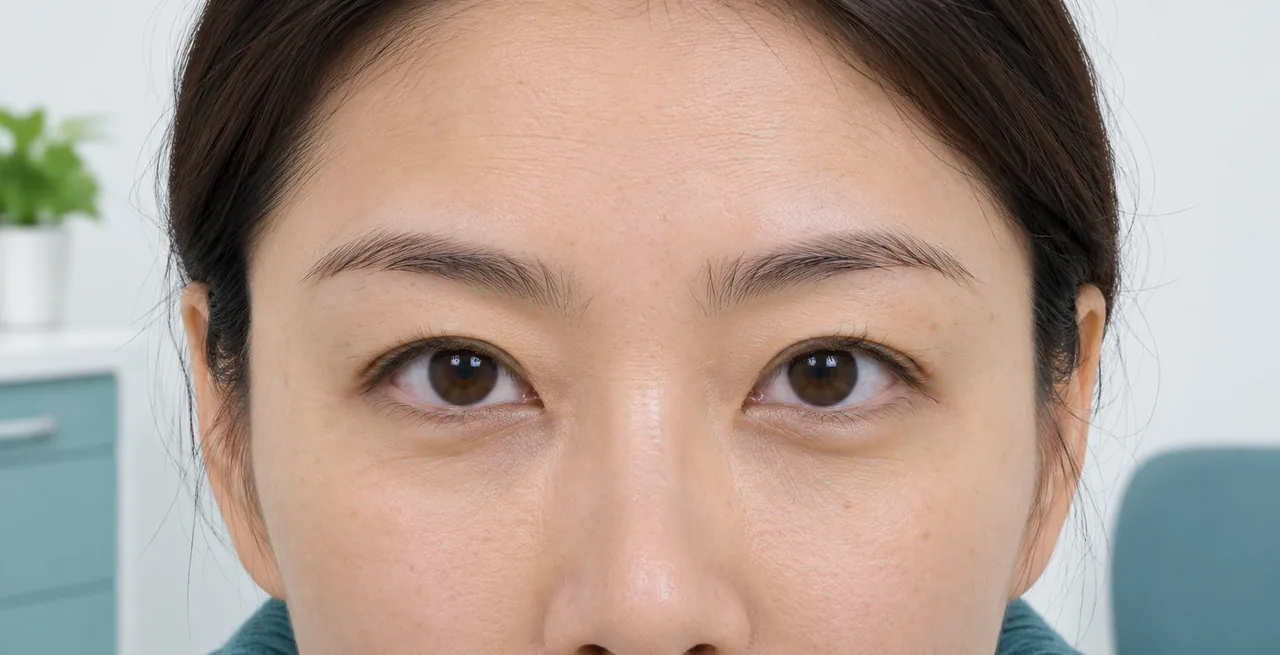
What it is
A sub-brow lift is an operation for loose, hooded upper-eyelid skin. Instead of cutting in the eyelid crease, the surgeon removes a band of skin, with some underlying tissue and muscle, just under the eyebrow [1] [2]. Published papers call it infra-brow lift, infrabrow blepharoplasty or sub-brow blepharoplasty [1] [2] [3]. A 2020 Korean journal report describes it as a common way to rejuvenate ageing upper eyelids in Asian patients [2].
It is different from a forehead or endoscopic brow lift, which lifts the brow through incisions elsewhere. A 2025 study states that the procedure does not significantly raise the brow. Its aim is to treat upper-eyelid skin laxity while preserving the existing eyelid fold [1]. Clinics may use the name differently, so it is worth confirming exactly what is planned.
What it involves
In the studies reviewed, the incision runs along the lower edge of the eyebrow. A crescent- or band-shaped strip of skin and part of the orbicularis muscle underneath is removed, and the wound is closed so the scar sits at the brow line [1] [2]. Variants exist, such as a parallel-edged excision instead of an elliptical one, and some include work on the fat under the brow [1] [2]. This guide does not describe surgical steps.
Reasons to discuss it with a clinician and limits
- It is generally discussed for lax, hooded upper-lid skin, especially at the outer side, when the lid-lifting muscle works normally. The 2020 series excluded people with weak lid-lifting function [2].
- Those authors advise against it for people who do not accept a scar under the brow, or who do not want the distance between brow and eyelid to shorten [2].
- Removing lax lid skin can reduce the forehead effort some people use to hold their brows up, so the brow may settle lower afterwards. A 2024 study found the amount of change varied between individuals [3]. People with drooping brows may need a different or additional procedure [1] [3].
- Limit: the evidence comes from single-centre studies of Asian patients, mostly women, without control groups [1] [2].
Risks and considerations
- A visible scar at the lower edge of the brow is the main trade-off. In the 2020 series it became inconspicuous over about three months as brow hair grew back [2].
- That series also reported temporary numbness, tingling or itching near the inner brow, small puckers of excess skin at the ends of the scar ("dog-ears") treated with injections, and one minor revision. No major complications were reported [2].
- The 2025 study reported no complications during follow-up. However, about a quarter of patients did not complete follow-up, and its brow-measurement results conflicted with its own conclusions [1].
- A change in brow position, usually slightly lower, and a shorter brow-to-lid distance are possible effects to discuss in advance [2] [3].
None of these studies was designed to measure how often uncommon complications occur, so the absence of reported problems does not mean there is no risk.
Recovery and follow-up
In the 2020 series, stitches were removed about four to five days after surgery. Redness and swelling settled quickly, and patients returned to daily activities using brow makeup or sunglasses to cover the incision [2]. Numbness or itching mostly resolved within about a month, and the scar usually became hard to see by about three months [2]. These are one hospital's observations, not standard timelines, and healing varies from person to person. The treating team should set follow-up.
Questions to ask
- Is my concern lax eyelid skin, a low brow, or both, and is a sub-brow lift the right match?
- Exactly where will the incision and scar be, and how visible might it be for my brows (including any brow tattoo)?
- Could my brow sit lower afterwards, and how would that be handled?
- Is my lid-lifting function normal, or is there ptosis that needs a different approach?
- What follow-up is planned for scar and brow position?
Educational information. AI editorial and source checking are not clinical review. Checked 16 Nov 2026.
- Category
- Facial
- General estimate
- Not availableNo reviewed estimate exists. Clinic prices, when published, appear on each clinic profile.
Doctors who list sub-brow lift
No doctors documented for this procedure yet.
A doctor appears here only when their scope is documented for this procedure at an exact clinic location.
Clinics that list sub-brow lift
Offering evidence from each clinic’s own website. Availability and suitability need confirmation with the clinic.
No clinics list it yet.
Sources
Clinical references
- Evaluation of morphological and psychological outcomes after sub-brow blepharoplasty · Frontiers in Surgery, 2025 (Wang, Li, Pang); doi:10.3389/fsurg.2025.1658806 · Checked 16 Nov 2026
- Parallel-excision infrabrow blepharoplasty with extensive excision of the orbicularis oculi muscle in an Asian population · Archives of Plastic Surgery, 2020;47(2):171-177 (Lee YJ et al.); doi:10.5999/aps.2019.01102 · Checked 16 Nov 2026
- Choosing Upper Blepharoplasty, Infra-brow Lift, and Forehead Lift in Asians: An Algorithmic Approach from Personal Experience · Aesthetic Plastic Surgery, 2024;48(4):644-651 (Park NS; Europe PMC record) · Checked 16 Nov 2026
- Catalogue source
- Source
This page is for research. It is not medical advice and is not a recommendation. Whether a treatment suits you, its risks and its cost need an individual consultation with a licensed doctor.
Online correction reports are not open yet.