
Ptosis correction
눈매교정 · Korean term
Ptosis correction is surgery to raise a drooping upper eyelid. Depending on how well the eyelid-lifting muscle works, it usually tightens or reattaches that muscle's tendon or uses the forehead muscle through a sling. Finding the cause of the droop comes first, and the main risks are under- or over-correction, uneven lids and eye-surface dryness.
On this page
Overview
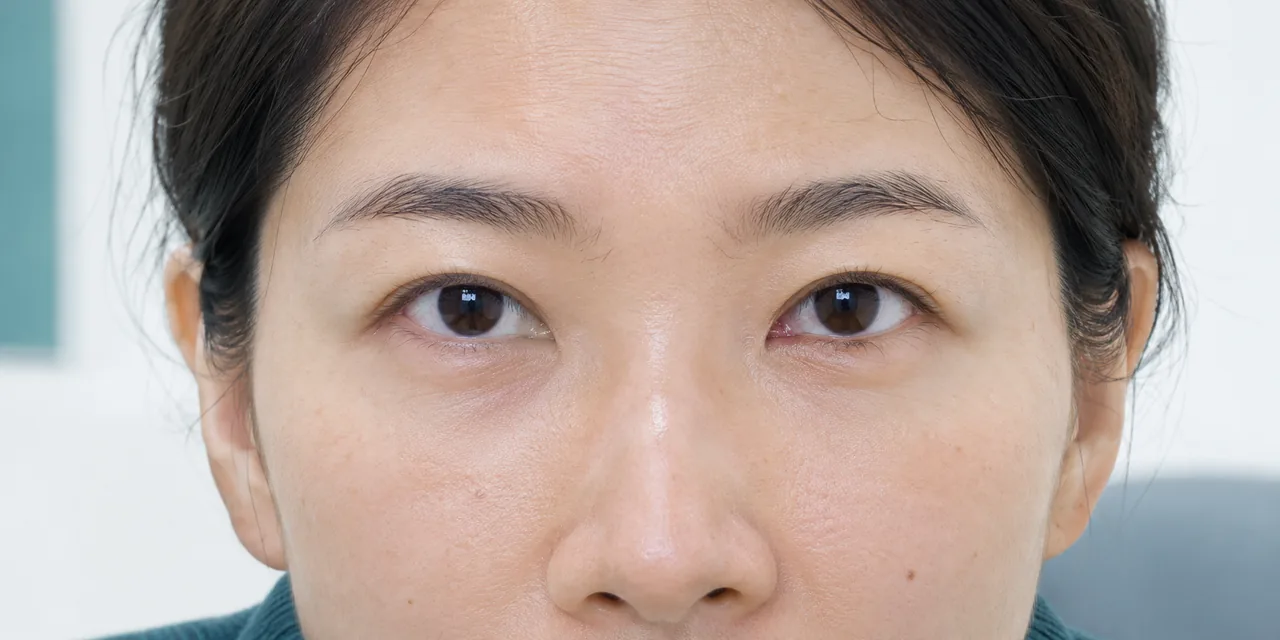
What it is
Ptosis means the edge of the upper eyelid sits lower than it should. Loose upper-lid skin (dermatochalasis) can look similar, and the two can occur together [1]. Drooping most often happens because the muscle that raises the lid is weak, the nerves to it are damaged, or the skin is loose. It can be present from birth, come with ageing, or follow injury or disease [1]. Conditions linked to drooping include diabetes, Horner syndrome, myasthenia gravis, stroke and tumours around the eye. If one of these is found, it is treated [1].
The most common acquired form is age-related stretching or detachment of the lifting muscle's tendon (the levator aponeurosis). Repeated lid traction, such as frequent eye rubbing or long-term contact lens use, eye surgery and trauma are other causes [4]. Surgery is used mainly for appearance in milder cases. It may be needed in more severe cases where drooping blocks vision [1].
What it involves
The approach depends largely on levator function, which is how well the lifting muscle moves the lid [4]. When function is adequate, the lifting muscle's tendon is tightened or advanced. This is done through a skin-crease incision or from the inner surface of the lid, an approach that avoids a visible scar in suitable patients [4] [2]. When levator function is poor, surgeons may use the forehead muscle instead, through a frontalis sling or frontalis advancement [4]. Eyelid surgery of this kind is usually done with numbing medicine and relaxing medicine, and most people go home the same day [2].
For children with severe congenital ptosis, a 2026 American Academy of Ophthalmology evidence report compared frontalis flap, frontalis suspension and maximal levator resection. Success and exposure outcomes overlapped substantially. However, the evidence was too limited to show the techniques are equivalent, and the authors suggested each technique's risk profile may guide the choice [3]. That report concerns children and may not apply to adults with acquired ptosis.
Reasons to discuss it with a clinician and limits
- MedlinePlus advises contacting a provider if drooping affects appearance or vision, if one eyelid suddenly droops or closes, or if drooping comes with double vision or pain [1].
- In children, more severe drooping can cause amblyopia ("lazy eye"), and surgery may be needed to prevent long-term vision loss. MedlinePlus advises seeing an eye specialist [1].
- Assessment typically measures lid height and levator function. It may test for fluctuating causes such as myasthenia gravis or statin-associated ptosis, and checks for dry eye and incomplete lid closure, which raise the risk of eye-surface problems after surgery [4].
- Lifting one lid can reveal drooping in the other lid that was not obvious before. EyeWiki says this should be discussed before surgery [4].
- Limit: no adult outcome data were retrieved, and the 2026 comparative report concerns children only [3].
Risks and considerations
Undercorrection is described as the most common complication. Overcorrection, uneven lid contour, uneven creases, wound problems, infection, exposure of the eye surface (exposure keratopathy) and incomplete closure (lagophthalmos) can also occur [4]. Getting the two sides to match is often the hardest goal [4]. Changes in corneal shape after surgery can alter a glasses prescription, and these changes often settle within a year [4].
General eyelid surgery risks include dry eyes, swelling, difficulty closing the eyes during sleep, uneven healing, scarring and mismatched lids. Rarely, the eye or vision can be damaged [2]. Frontalis suspension in children has been linked to sling infection, extrusion and granuloma, and frontalis flap to lid displacement on upward gaze [3].
Recovery and follow-up
Most people go home the same day [2]. For eyelid lift surgery generally, MedlinePlus describes vision usually being good after 2 to 3 days, bruising for 2 to 4 weeks and avoiding strenuous activity for about 3 weeks [2]. These timings are not specific to ptosis repair, and individual recovery varies.
Swelling can make the lid look lower for a while after surgery. EyeWiki describes observing lid height until swelling settles. Mild overcorrection may be managed with massage over months, and further surgery is considered when under- or overcorrection causes symptoms [4]. Follow-up usually checks lid height, symmetry and the eye surface.
Questions to ask
- What is causing my drooping, and have underlying conditions been checked?
- How is my levator function, and which approach is proposed as a result?
- Could lifting one lid change the other?
- How likely is under- or overcorrection for me, and how would it be handled?
- How will dry eye, eye closure and my glasses prescription be monitored afterward?
Educational information. AI editorial and source checking are not clinical review. Checked 16 Nov 2026.
- Category
- Facial
- General estimate
- Not availableNo reviewed estimate exists. Clinic prices, when published, appear on each clinic profile.
Doctors who list ptosis correction
No doctors documented for this procedure yet.
A doctor appears here only when their scope is documented for this procedure at an exact clinic location.
Clinics that list ptosis correction
Offering evidence from each clinic’s own website. Availability and suitability need confirmation with the clinic.
No clinics list it yet.
Sources
Clinical references
- Eyelid drooping: MedlinePlus Medical Encyclopedia · U.S. National Library of Medicine (MedlinePlus; content by A.D.A.M.) · Checked 16 Nov 2026
- Eyelid lift: MedlinePlus Medical Encyclopedia · U.S. National Library of Medicine (MedlinePlus; content by A.D.A.M.) · Checked 16 Nov 2026
- Severe Congenital Ptosis Repair: A Report by the American Academy of Ophthalmology · Ophthalmology, 2026;133(7):909-915 (Europe PMC record, PMID 42059847) · Checked 16 Nov 2026
- Aponeurotic Blepharoptosis (Ptosis) · EyeWiki, American Academy of Ophthalmology · Checked 16 Nov 2026
- Catalogue source
- Source
This page is for research. It is not medical advice and is not a recommendation. Whether a treatment suits you, its risks and its cost need an individual consultation with a licensed doctor.
Online correction reports are not open yet.