
Lower blepharoplasty
하안검수술 · Korean term
Lower blepharoplasty is surgery on the lower eyelid for under-eye bags, loose skin, lid laxity or a tear-trough hollow. Fat may be removed, repositioned or supplemented, through the inside of the lid or through the skin. Risks include lid position changes, eye-surface swelling and dryness, and the evidence on which approach works best is limited.
On this page
Overview
What it is
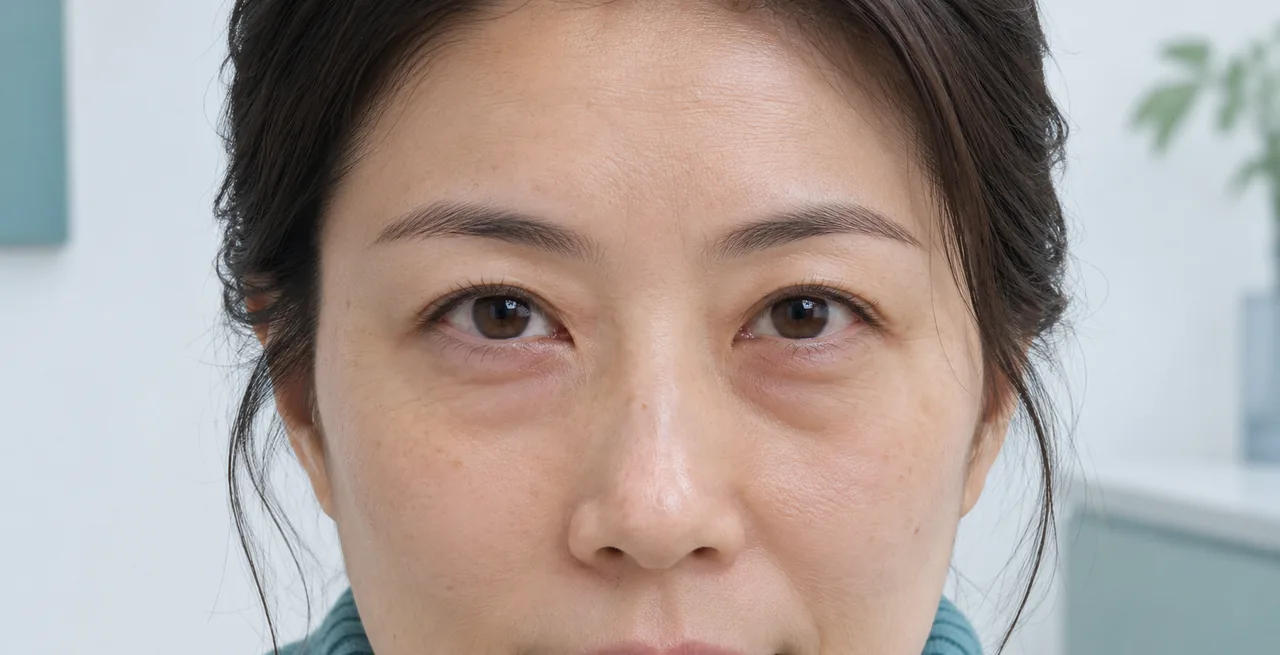
Lower blepharoplasty is surgery on the lower eyelid. A 2017 review lists the age-related changes it addresses: bulging orbital fat, a tear-trough hollow, lid laxity and excess skin [2]. The NHS says that for the lower eyelids, the surgeon may reposition or remove fat from under-eye bags and sometimes remove a small amount of skin [1].
What it involves
There are two main approaches. The transcutaneous approach uses an incision just below the lashes. The transconjunctival approach works from the inside of the lid [2]. The 2017 review notes a trend towards the inside approach when more than simple skin removal is needed [2].
A 2025 systematic review describes the trade-offs. The skin approach gives more working room and allows skin removal or lid support at the same time, but leaves an external scar. The inside approach avoids a visible scar and suits younger people who do not need skin removed [3]. Fat can be removed, repositioned or supplemented with filler or fat grafts [2]. The newer review frames fat preservation as part of a move away from removing fat alone, which the authors say can leave a hollow look over time [3].
Support for the outer corner of the lid, such as canthopexy, is sometimes added to help the lower lid while it heals [7]. The procedure is usually done as day surgery [1].
Reasons to discuss it with a clinician and limits
- The concern may be bags, a hollow, loose skin or a loose lid. Each points to different options, and the best option depends on that person's anatomy.
- The 2025 review found no clear difference in satisfaction or complication rates between the two approaches. However, inconsistent reporting in the studies makes it hard to identify a best approach [3].
- Most studies in that review involved relatively young Asian patients having surgery through the inside of the lid. This is relevant context for people researching in Korea, but the authors note it limits wider generalisation [3].
- Limit: several retrieved sources are general blepharoplasty pages, and none gives a lower-lid-specific recovery timeline.
Risks and considerations
A review of blepharoplasty complications groups problems by timing. First-week problems include corneal scratches and bleeding behind the eye that can threaten vision. Problems within the first six weeks include lid malposition, eye misalignment, corneal exposure and excess tearing. Later problems include changes in lid height and contour, asymmetry, scarring and lasting swelling [4].
For lower-lid surgery specifically, the 2025 review describes lid malposition or outward turning, mainly after skin or deeper-layer manipulation. Other reported problems include eye-surface swelling (chemosis), prolonged swelling or bruising, lumpiness, residual bags, dry eye and numbness [3]. A Cambridge NHS trust leaflet notes that chemosis is typically associated with lower-lid surgery and can last weeks or months [6]. Rare serious NHS-listed complications include eye muscle injury, the lower lid turning outward, bleeding into the eye socket and vision impairment [1].
Even in a careful single-surgeon series, a few patients needed further treatment. In a 2025 report of 265 transcutaneous procedures, a small number needed injections for early scar tissue or corrective surgery for a pulled-down lid. Follow-up was short, a median of four months [5].
Recovery and follow-up
For eyelid surgery generally, the NHS describes most people going home the same day and taking about two weeks off work, depending on their job. Bruising and redness can take several weeks to fade [1]. During early healing it advises avoiding strenuous activity and swimming for a few days, and avoiding smoking, contact lenses and eye rubbing [1]. The Cambridge leaflet also asks patients to tell the team about their medicines, including aspirin-containing products, because of bleeding risk [6].
These timings are not specific to the lower lid, and chemosis can make recovery longer [6]. The treating team should give a lower-lid-specific plan.
Questions to ask
- Is my main concern fat bags, a hollow, loose skin or lid laxity, and does that change the approach?
- Would you remove, reposition or add volume, and why?
- Would you work through the inside of the lid or the skin, and what scar should I expect?
- Do I need lid-corner support, and how would lid malposition be handled if it happened?
- How long might swelling or chemosis last for me, and what should I report urgently?
Educational information. AI editorial and source checking are not clinical review. Checked 16 Nov 2026.
- Category
- Facial
- General estimate
- Not availableNo reviewed estimate exists. Clinic prices, when published, appear on each clinic profile.
Doctors who list lower blepharoplasty
No doctors documented for this procedure yet.
A doctor appears here only when their scope is documented for this procedure at an exact clinic location.
Clinics that list lower blepharoplasty
Offering evidence from each clinic’s own website. Availability and suitability need confirmation with the clinic.
No clinics list it yet.
Sources
Clinical references
- Eyelid surgery - NHS · NHS (England) · Checked 16 Nov 2026
- An Update on Lower Lid Blepharoplasty · Seminars in Plastic Surgery, 2017;31(1):46-50 (Murri M et al.; Europe PMC record) · Checked 16 Nov 2026
- Transconjunctival or Transcutaneous Approach for Fat-preserving Lower Lid Blepharoplasty? · Plastic and Reconstructive Surgery Global Open, 2025;13(12):e7345 (Atiyeh B et al.) · Checked 16 Nov 2026
- Blepharoplasty complications (Lelli GJ, Lisman RD) · Plastic and Reconstructive Surgery, 2010;125(3):1007-1017 (Europe PMC record) · Checked 16 Nov 2026
- Refining transcutaneous lower blepharoplasty: Key steps for minimizing complications · Saudi Journal of Ophthalmology, 2025;39(2):143-147 (Alhumaemydi R et al.) · Checked 16 Nov 2026
- Blepharoplasty (patient information) · Cambridge University Hospitals NHS Foundation Trust · Checked 16 Nov 2026
- Focus on the eyes: The ins and outs of canthopexy and canthoplasty · American Society of Plastic Surgeons · Checked 16 Nov 2026
- Catalogue source
- Source
This page is for research. It is not medical advice and is not a recommendation. Whether a treatment suits you, its risks and its cost need an individual consultation with a licensed doctor.
Online correction reports are not open yet.