
Canthoplasty
트임성형 · Korean term
Canthoplasty is surgery on the outer corner of the eye. It may be done to support a sagging lower lid or, cosmetically, to lengthen the eye opening and change the angle of the outer corner. Most evidence here comes from a professional-society overview and one surgeon-authored technique report, so outcome and recovery details are limited.
On this page
Overview
What it is
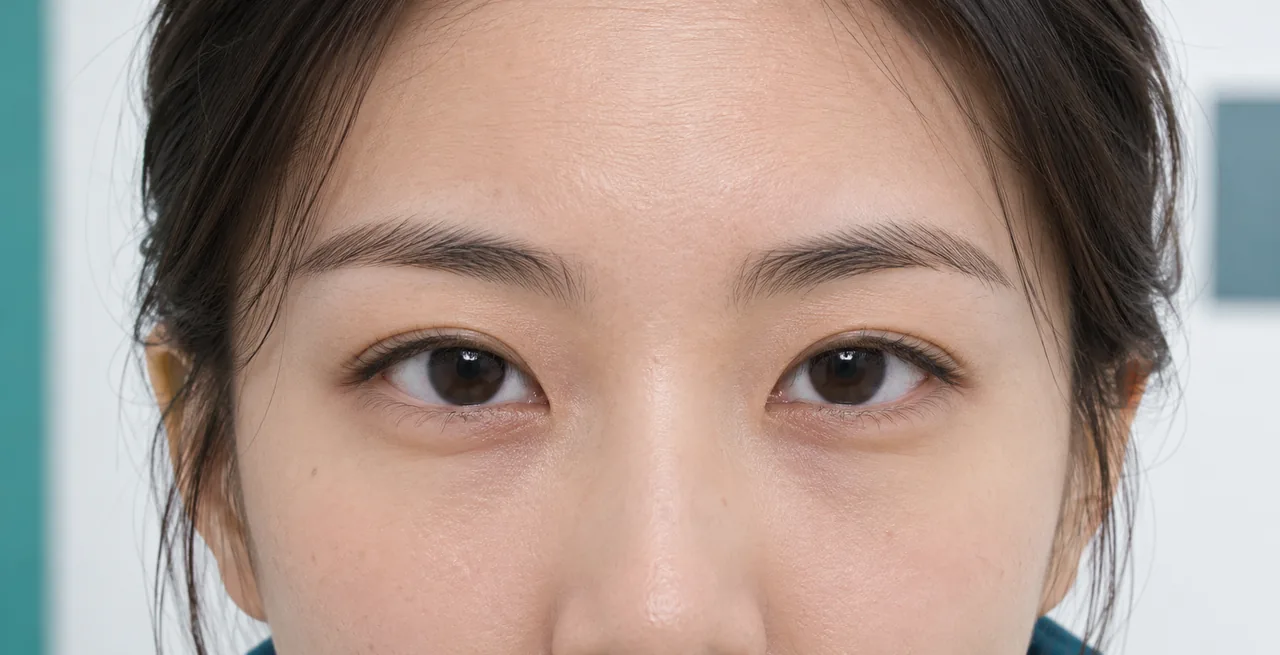
Canthoplasty is surgery on the lateral canthus, the outer corner where the upper and lower eyelids meet. The American Society of Plastic Surgeons (ASPS) describes it as a way to correct drooping or sagging of the lower lid and give it structural support. It can also lengthen the eye opening and lift the outer corner [1]. The ASPS contrasts it with canthopexy, a less invasive option that reinforces the existing corner structures. Canthoplasty is suited to cases needing more extensive restructuring [1].
A 2016 report in a Korean plastic surgery journal describes a cosmetic version, lateral canthoplasty. Its aim is to lengthen the outer corner angle and lower a raised outer tail of the eye so the eyes appear larger [2]. Supporting a sagging lid and changing eye shape for appearance are different goals, and it helps to be clear which one is being discussed.
What it involves
In the 2016 report, the operation is done under local anaesthetic through a small incision at the outer corner. Tissue at the corner is released and the lid is re-anchored inside the bony rim of the eye socket [2]. The authors stress precise incision placement and careful matching of the two corners. They note that it is often combined with other procedures, such as double-eyelid surgery or epicanthoplasty, depending on the person [2]. The ASPS also notes that canthal procedures can be combined with eyelid surgery [1].
The report illustrates three cases and is not a comparison study, so it cannot show how often results are achieved across patients [2].
Reasons to discuss it with a clinician and limits
The ASPS says the choice between canthoplasty and canthopexy depends on the person's anatomy before surgery and on the result they want [1]. The 2016 authors observed that results were less noticeable in some eyes. Examples include little space between the outer corner and the bone, a sunken eye, a downward-slanting outer corner, a small eye or orbit, or heavy upper-lid skin over the corner [2]. These are the authors' observations, not validated predictors.
Limit: no health-authority page or comparative outcome study on canthoplasty was retrieved for this guide.
Risks and considerations
The ASPS describes canthoplasty as having a higher risk profile and a longer recovery than canthopexy [1]. Complications listed in the 2016 report include bleeding and swelling of the eye surface, and uncommonly dellen, a small area of corneal thinning. Wound separation can leave a scar that may need later revision. Other listed problems are loss of lower-lid lashes, notch-shaped or visible lid-margin scarring, and outward turning of the lower lid [2].
More broadly, a review of eyelid surgery complications lists lid malposition, corneal exposure, excess tearing, contour changes, asymmetry and scarring among recognised problems [3]. Individual risk depends on the eyes, the plan and the surgeon.
Recovery and follow-up
The 2016 authors report that stitches were removed after about 5 to 7 days. Most swelling went down within a month, and eye-surface redness mostly settled within about three weeks. The incision line could stay red for about 2 to 3 months [2]. These are one group's observations, not standard timelines, and healing varies from person to person. The treating team should set the follow-up plan.
Questions to ask
- Is my goal lid support, eye shape, or both, and would canthopexy or no surgery be an option?
- Is canthoplasty being suggested together with other eye procedures, and how does that change the risks?
- Which features of my eyes might limit the result?
- What happens if a scar, lid position or asymmetry problem appears?
- Can I see results from similar cases treated by the surgeon, and who will handle my follow-up?
Educational information. AI editorial and source checking are not clinical review. Checked 16 Nov 2026.
- Category
- Facial
- General estimate
- Not availableNo reviewed estimate exists. Clinic prices, when published, appear on each clinic profile.
Doctors who list canthoplasty
No doctors documented for this procedure yet.
A doctor appears here only when their scope is documented for this procedure at an exact clinic location.
Clinics that list canthoplasty
Offering evidence from each clinic’s own website. Availability and suitability need confirmation with the clinic.
No clinics list it yet.
Sources
Clinical references
- Focus on the eyes: The ins and outs of canthopexy and canthoplasty · American Society of Plastic Surgeons · Checked 16 Nov 2026
- Cosmetic Lateral Canthoplasty: Lateral Canthoplasty to Lengthen the Lateral Canthal Angle and Correct the Outer Tail of the Eye · Archives of Plastic Surgery, 2016;43(4):321-327 (Chae SW, Yun BM) · Checked 16 Nov 2026
- Blepharoplasty complications (Lelli GJ, Lisman RD) · Plastic and Reconstructive Surgery, 2010;125(3):1007-1017 (Europe PMC record, PMID 20195127) · Checked 16 Nov 2026
- Catalogue source
- Source
This page is for research. It is not medical advice and is not a recommendation. Whether a treatment suits you, its risks and its cost need an individual consultation with a licensed doctor.
Online correction reports are not open yet.